


ERNEST RANCOULET
Ernest Rancoulet is one of those nineteenth-century sculptors whose work has survived more clearly than the man himself.
Born in Sorèze in southern France on April 5, 1842, Rancoulet had an unexpected beginning for a sculptor of elegant Belle Époque figures. A biographical account published during his lifetime records that he spent more than a decade at sea, working as a marin from 1855 until 1866.
If those dates are correct, Rancoulet went to sea at about thirteen and remained there into his early twenties. What kind of sailor he was—and on which ships—has not yet been established. Whether he served aboard naval vessels, merchant ships or in another maritime trade remains an open question.
Intriguingly, Rancoulet later created a sculpture titled Le Marin—The Sailor. Whether the subject held any autobiographical significance for him is unknown, but after eleven formative years at sea, the connection is difficult not to notice.
A SCULPTOR EMERGES
After leaving the sea, Rancoulet studied sculpture in Bordeaux before continuing his training under the distinguished French sculptor Eugène Lequesne. By 1867 he was exhibiting in Bordeaux, and in 1868 he received a Bordeaux scholarship to continue his studies at the École des Beaux-Arts in Paris. His work subsequently appeared at the Paris Salon.
Those years of academic training are evident in his sculpture. His figures are naturally proportioned and carefully modeled, with
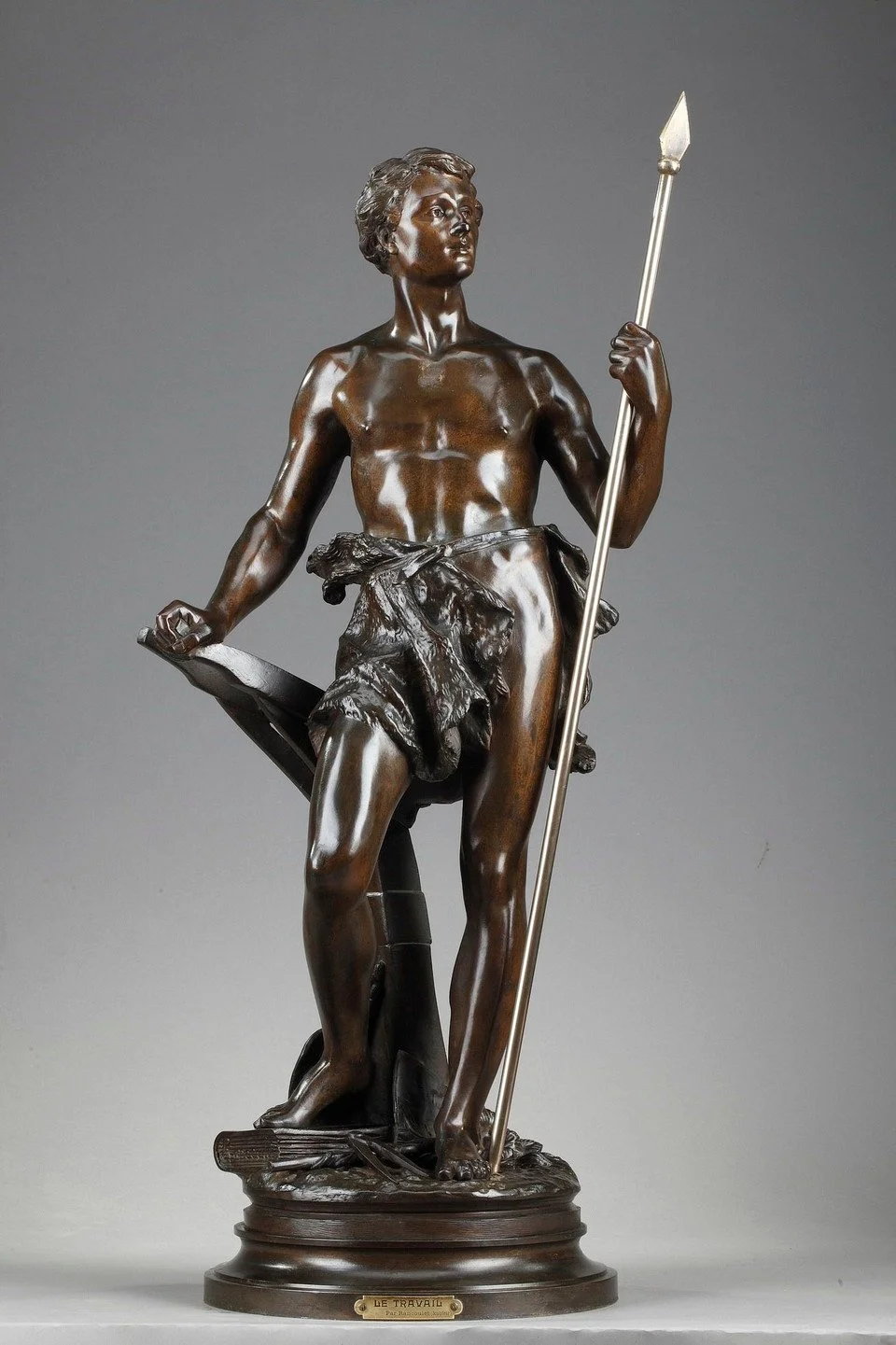
Le Travail (Work)
Ernest Rancoulet
Bronze, c. 1870
particular attention to posture, drapery, expression and the small details that give his subjects character.
Rancoulet moved comfortably between the traditional and the familiar. Classical, mythological and allegorical figures appear alongside workers, sailors and scenes drawn from everyday life.
Whether depicting a hero from antiquity or an anonymous young laborer, his figures often possess a quiet sense of narrative.
FROM THE SALON TO THE DRAWING ROOM
Rancoulet was not simply a manufacturer of bronze statuettes. He was a trained sculptor whose models became part of the flourishing nineteenth-century market for sculpture intended for private ownership.
His designs appeared in a wide variety of forms and materials, ranging from substantial bronzes to smaller decorative figures. They were also incorporated into the broad category of French bronzes d’ameublement—sculptural decoration made for the domestic interior, including clocks, lamps, candelabra, inkstands and other decorative objects.
At least some of Rancoulet’s designs entered this commercial market through outside manufacturers and bronze founders. A surviving bronze portrait of the French statesman Léon Gambetta, for example, carries both Rancoulet’s signature and the mark of the founders Monméja and Gourp. Period commercial references also associate examples of his work with the Maison Alix Levy.
By 1891, a Paris directory listed Ernest-Henri Rancoulet, statuaire, at 87 rue Oberkampf, placing him firmly within the artistic and commercial world of late nineteenth-century Paris.
The objects themselves suggest how widely his work circulated. They vary considerably in size, material and finish—evidence of a sculptor whose designs reached beyond individual commissions into a much broader decorative market.
These were not necessarily sculptures destined for museums or public squares.
Many were objects people actually lived with.
They stood on mantelpieces, library shelves and drawing-room tables. They were purchased, inherited and moved from one home to another.
And some were kept for generations.
WHAT SURVIVES
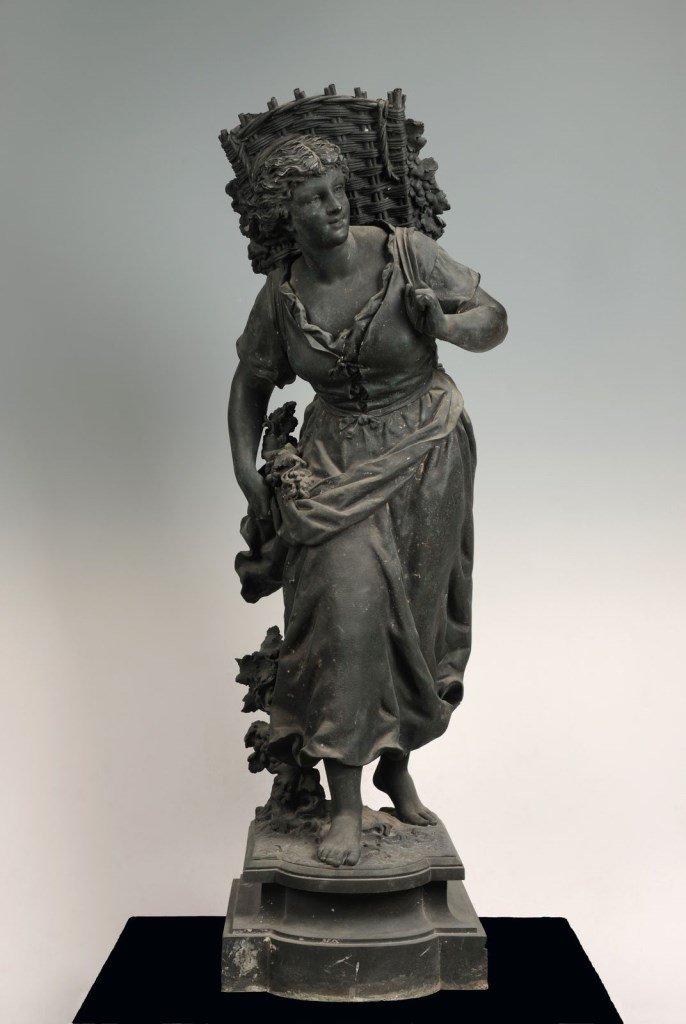
Jeune femme à la hotte
Ernest Rancoulet
Bronze
Musée des Beaux-Arts de Reims
Occasionally, a surviving Rancoulet sculpture allows part of that journey to be reconstructed.
The Musée des Beaux-Arts de Reims holds his large bronze Jeune femme à la hotte, also known as Vendangeuse or La Vendange. The sculpture belonged to the private collection of Victor Lambert before entering the museum through his bequest in 1912. The museum records Rancoulet’s signature as having been incised into the model before the bronze was cast. A related version is preserved by the Musée de la Chartreuse de Douai.
Other Rancoulet sculptures continue to emerge from private collections and estates more than a century after they were made.
Yet the man who created them remains surprisingly elusive.
THE PROBLEM OF ERNEST RANCOULET
For a sculptor whose works appear with some regularity today, Rancoulet’s documentary history is remarkably confused.
Even basic dates have become muddled. Modern references sometimes give 1870 as his birth year—a date impossible to reconcile with contemporary evidence that he was already exhibiting sculpture during the 1860s.
His death date is less certain. Institutional records themselves disagree, with the Musée d’Orsay currently recording his death in Bordeaux in 1905, while the Musée des Beaux-Arts de Reims gives 1915.
For that reason, What We Keep does not presently treat either date as conclusively established.
Our research has also yet to locate an authenticated contemporary photograph or portrait of Rancoulet in a readily accessible public collection.
It creates a curious reversal.
We can find his name in nineteenth-century records. We can trace his education, place him in Paris, identify surviving sculptures, examine signatures and foundry marks, and occasionally follow individual works through more than a century of ownership.
But Rancoulet himself remains strangely difficult to see.
What survives most clearly is what he made.
We know Rancoulet increasingly through the things people chose to keep.
THE BOY WITH THE RAKE
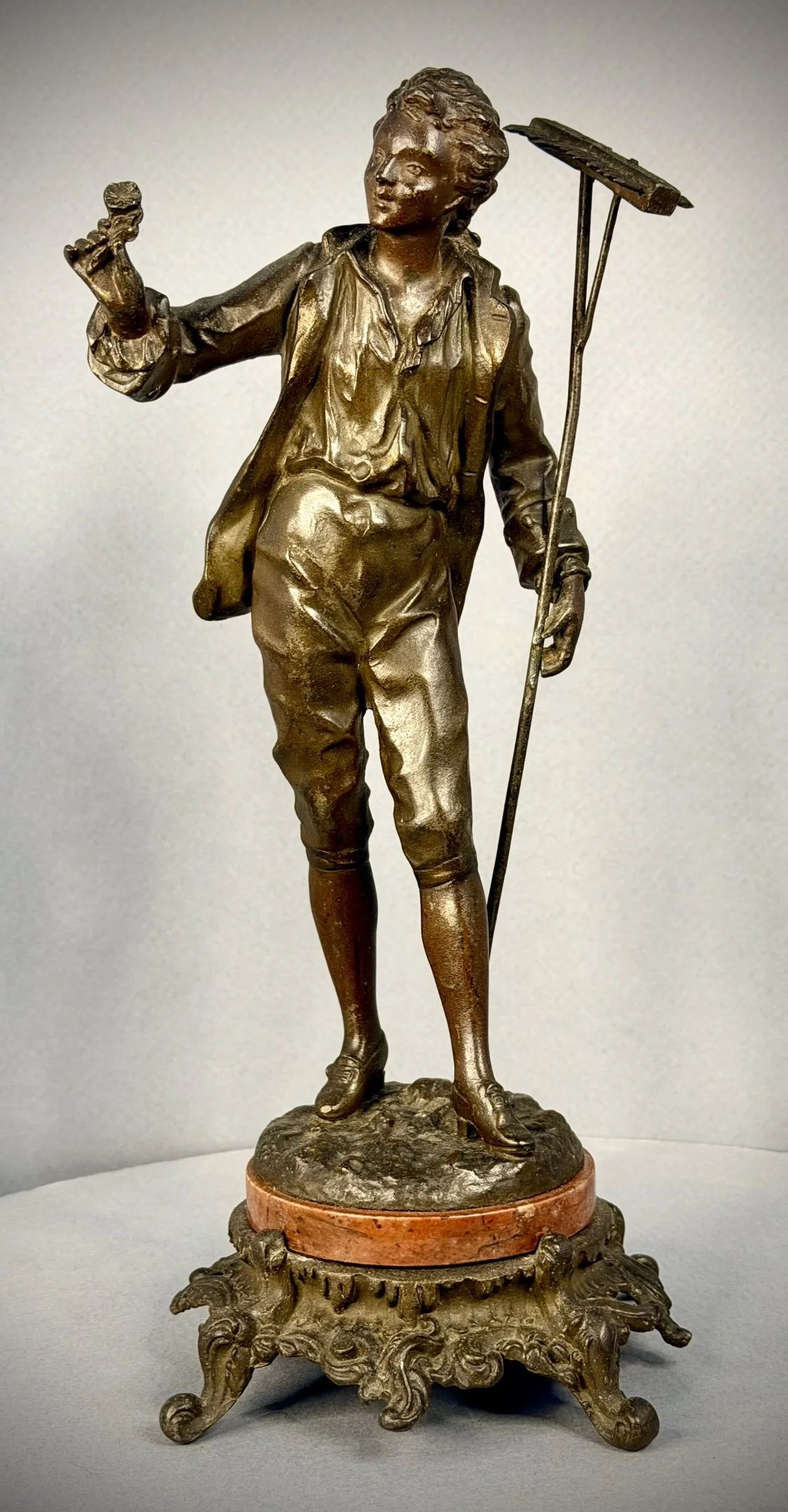
The Boy With the Rake
Ernest Rancoulet
Bronze, c. 1900
What We Keep Collection
This small figure belongs to the quieter, more intimate side of Rancoulet’s work.
There is no god, hero or grand allegory here. Instead, a young agricultural laborer stands with one of the simplest tools of rural life.
The careful modeling of the figure, his relaxed stance and the rake itself transform an ordinary subject into a small narrative. It is precisely the kind of sculpture that could have found a place in a late nineteenth-century domestic interior.
There are, however, things we still do not know.
No period catalogue has yet been located identifying this exact model. For now, The Boy With the Rake should therefore be regarded as a descriptive title rather than a confirmed original title. We have also not yet identified the foundry responsible for this example or established precisely when the model was first produced.
Those questions remain part of the continuing research.
THIS EXAMPLE
When this particular sculpture appeared for sale, there was little in the listing to suggest what it might be.
The photographs were dark, the description was minimal, and the figure was offered simply as an old decorative bronze. It was purchased for $23.50.
Only after closer examination did the signature become significant and the search for Ernest Rancoulet begin.
There was another small detail.
At some point during the sculpture’s life, the rake had become separated from the boy’s hand.
It would have been remarkably easy to lose. Long, thin and detachable, once separated from the figure there was little to prevent it from disappearing during a move, an estate dispersal, a sale or simply decades of storage.
Yet it remained with him.
We cannot know how many people owned this sculpture before it reached this collection, where it stood in their homes, or how often it changed hands. But somewhere along the way, each successive custodian—or perhaps one particularly careful one—understood that the loose little rake belonged to the boy.
More than a century after the sculpture was made, the two are still together.
Sometimes an object’s history survives in an inscription, a receipt or an old collection label.
Sometimes it survives simply because someone thought a small, easily misplaced piece was worth keeping.

RESEARCH NOTE
Historical information concerning Ernest Rancoulet remains unusually contradictory. What We Keep favors contemporary records, museum collections and identifiable period sources wherever possible. Information that cannot yet be independently established is identified as uncertain rather than presented as fact.
Research into Rancoulet and The Boy With the Rake is ongoing. This record may be revised as additional documentary evidence is discovered.
SOURCES & FURTHER READING
Musée d’Orsay — Ernest Rancoulet
Artist record and biographical information.
Musée d’Orsay: Ernest Rancoulet
Musée des Beaux-Arts de Reims — Jeune femme à la hotte
Museum collection record for Rancoulet’s bronze, including provenance and object information.
Musée des Beaux-Arts de Reims: Jeune femme à la hotte
Inventaire du patrimoine de Domfront — Ernest Rancoulet
Biographical and commercial information concerning Rancoulet, his exhibitions and decorative models.
Inventaire du patrimoine: Ernest Rancoulet
Édouard Féret — nineteenth-century biographical record
A period account preserving Rancoulet’s April 5, 1842 birth date and his years as a marin from 1855 to 1866.
Biographical material derived from Édouard Féret
Additional object and period research
Surviving signed sculptures, foundry marks, Salon records, commercial catalogues and historical auction records have been consulted in reconstructing Rancoulet’s career.
For more information, watch the video